
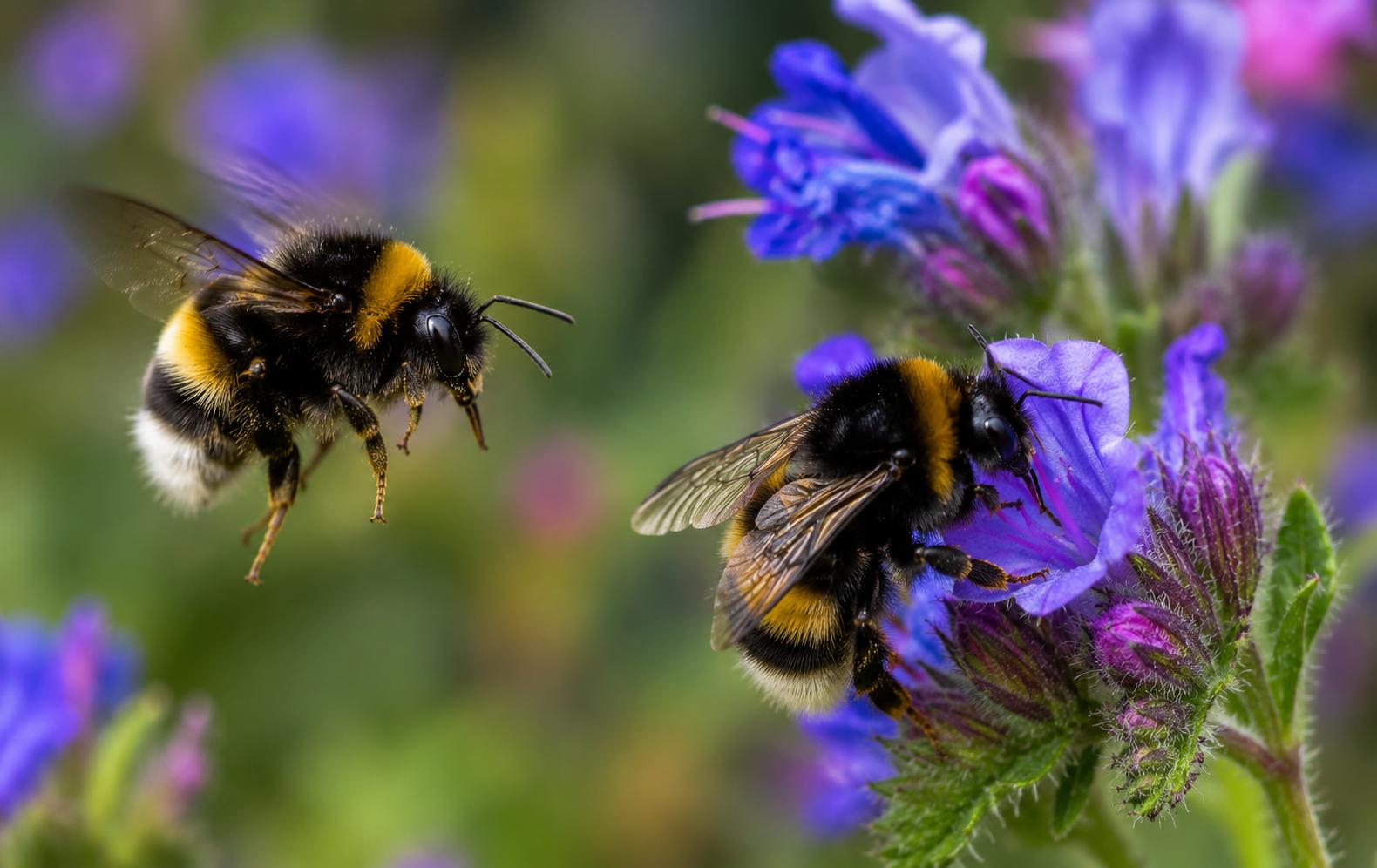
Male bumblebees are more active and behaviourally adaptable than female worker bees, according to a new UK study exploring how bees learn, forage, and respond to changing environments.
The research, led by the University of Chester in collaboration with Newcastle University, the University of Sheffield, and Toyota Motor Manufacturing UK Ltd in Deeside, sheds new light on the behavioural differences between male and female bumblebees and how these differences may influence survival and foraging strategies.
Published in the journal Animal Cognition, the study focused on Bombus terrestris, commonly known as the buff-tailed bumblebee, one of the UK’s most widespread bee species. Researchers examined how male drones and female worker bees explored unfamiliar environments, learned colour associations linked to food rewards, and adapted when those rewards changed.
While previous bee cognition studies have often focused heavily on female worker bees because of their central role within colonies, the latest research shifts attention towards male bumblebees and their unique behavioural traits.
How Researchers Tested Bee Intelligence and Flexibility.
To analyse bee behaviour, researchers created a series of specially designed exploration and learning tasks using large rectangular test boxes divided into ten connected compartments. The bees were free to move between compartments, allowing scientists to measure activity levels and exploratory behaviour in a completely new environment.
The first task assessed how active the bees were while navigating unfamiliar surroundings. Researchers then introduced colour-based learning exercises involving artificial flower pairs in blue and yellow. Bees were trained to associate one flower colour with a sucrose reward.
In the final stage of the experiment, the rewarded flower colour was reversed to test behavioural flexibility - essentially measuring how quickly the bees could adapt and relearn when conditions changed.
The results showed clear behavioural differences between male and female bees.
Male bumblebees spent significantly more time actively exploring the unfamiliar environment than female worker bees. Although both sexes performed similarly when initially learning colour-reward associations, male bees adapted much faster when the reward colour changed, demonstrating greater behavioural flexibility.
Why Male Bumblebees Behave Differently.
According to researchers, these behavioural differences are closely linked to the distinct roles male and female bees play within bumblebee colonies.
Dr Pizza Ka Yee Chow, Lead Researcher and Senior Lecturer in Psychology at the University of Chester, explained that female worker bees act as the primary foragers for the colony and benefit from shared food stores inside the nest. Male drones, however, eventually leave the colony and become solitary foragers focused primarily on survival and reproduction.
Dr Chow said males’ increased activity levels may reflect exploratory behaviours linked to locating mates and searching for profitable food sources in changing environments.
“Males’ active time may reflect their exploratory behaviour such as pre-mating patrolling, and their enhanced flexibility suggests their readiness to find new profitable flowers when exploited flowers decrease in quality,” Dr Chow explained.
“These results highlight the importance of behavioural and cognitive traits for males, which may increase their chance of finding mates and improve their foraging efficiency.”
Female Bees May Benefit From Staying Consistent.
Researchers also believe female workers’ lower flexibility may actually provide long-term advantages for their colonies.
Dr Théo Robert, Research Associate at Newcastle University and co-author of the study, explained that female worker bees can afford to repeatedly revisit high-quality flowers even when those resources temporarily decline because they have support from the colony’s food reserves.
This strategy may allow worker bees to compete more effectively with other pollinators for valuable nectar sources over time.
“Males’ main role is reproduction, so they do not need to compete for the best flowers but simply sustain themselves long enough to mate with virgin queens,” Dr Robert said.
“Therefore, it may be more profitable for them to switch to different flowers when those on which they have previously learned to feed become depleted.”
The findings suggest that female bees may prioritise long-term foraging efficiency for the colony, while males adopt more flexible behaviours focused on individual survival.
New Insights Into Bee Cognition and Pollinator Behaviour.
The study also highlights the growing scientific interest in bee intelligence and animal cognition research. Bees have increasingly been recognised as highly intelligent insects capable of learning, problem-solving, and adapting their behaviour based on environmental conditions.
However, researchers noted that male bee cognition has historically been overlooked in scientific studies, despite the important ecological role male bees play in reproduction and pollination systems.
Dr Chow said the findings demonstrate the importance of studying behavioural differences between sexes in species where males and females perform very different ecological roles.
The researchers hope the study will encourage broader investigations into how cognitive traits evolve in pollinators and how behavioural flexibility may help species adapt to environmental pressures such as habitat loss and climate change.
Growing Importance of Pollinator Research.
The latest findings arrive amid increasing concern over declining bee populations and pollinator health across the UK and globally. Bumblebees play a critical role in pollinating crops, wildflowers, and ecosystems, making research into bee behaviour and adaptability increasingly important for conservation efforts.
Understanding how bees respond to changing environments, depleted food sources, and competition from other pollinators may help scientists develop better conservation strategies in the future.
The research paper, Male bumblebees (Bombus terrestris) are more active and behaviourally flexible than workers, was published in Animal Cognition and involved contributions from researchers and students at the University of Chester, Newcastle University, and the University of Sheffield.
Lifestyle News
Male Bumblebees More Active and Adaptable Than Female Bees, New UK Study Finds
Advertisement





Comments (0)
You must be logged in to post comments.
Don't have an account? Register here
No comments yet. Be the first to share your thoughts!