
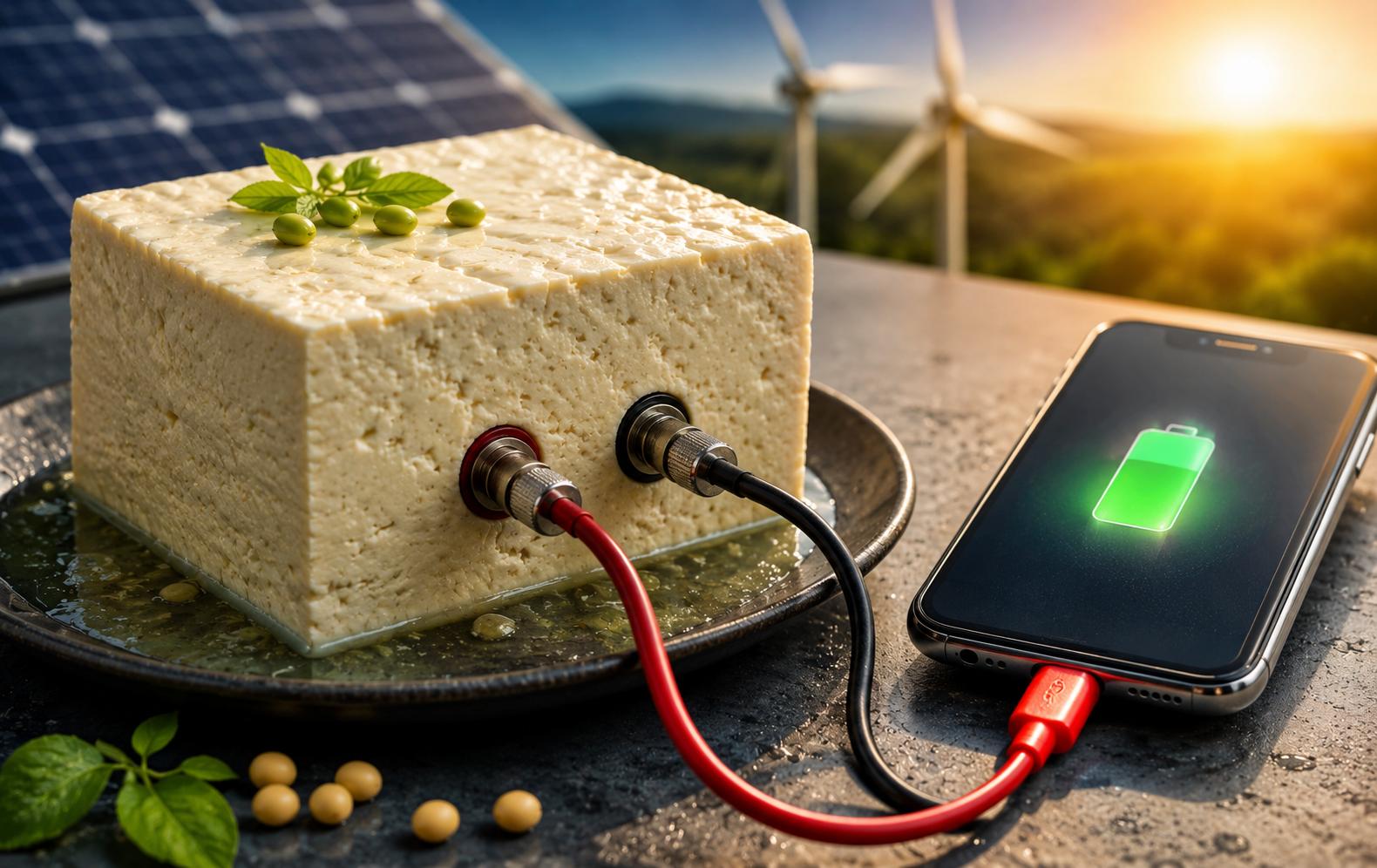
A surprising breakthrough in battery technology is attracting global attention after scientists developed a new water-based battery system inspired by tofu brine that could dramatically change the future of renewable energy storage.
Researchers from the City University of Hong Kong and the Southern University of Science and Technology in China have created a battery using non-toxic materials and a neutral electrolyte solution similar to the mineral-rich brine traditionally used during tofu production. Early results suggest the technology could last far longer than current lithium-ion batteries while also reducing environmental risks linked to mining and disposal.
The unusual invention has quickly become one of the most talked-about developments in sustainable energy research because of its potential to provide safer, cleaner and more durable battery systems for everything from renewable energy grids to electric vehicles.
Scientists believe the breakthrough could help address some of the biggest concerns surrounding modern battery production, including fire risks, toxic waste and reliance on rare earth materials.
Why Scientists Are Looking Beyond Lithium-Ion Batteries.
Lithium-ion batteries currently power most modern technology, including smartphones, laptops, electric cars and renewable energy storage systems. However, concerns over lithium extraction, environmental damage and battery safety have intensified in recent years.
Mining lithium requires enormous amounts of water and energy, while the global supply chain remains heavily concentrated in a small number of countries. Environmental groups have repeatedly warned that rising battery demand could create long-term sustainability problems if alternative technologies are not developed.
Traditional lithium-ion batteries also carry well-known fire risks. Damage, overheating or manufacturing defects can trigger dangerous thermal runaway reactions capable of causing explosions or large-scale fires.
Researchers involved in the tofu brine battery project believe water-based systems could provide a safer and more environmentally friendly solution. Unlike lithium-ion cells, the new design uses a neutral water-based electrolyte rather than highly flammable chemicals.
The result is a battery that researchers claim is non-toxic, non-flammable and significantly safer to manufacture, transport and recycle.
How The Tofu Brine Battery Actually Works.
Despite the unusual name, the battery does not literally run on leftover tofu waste poured directly into a power cell. Instead, the technology uses a chemical composition similar to nigari, the mineral-rich brine commonly used in tofu production.
The electrolyte contains magnesium and calcium salts dissolved in water, creating a neutral pH environment that avoids many of the corrosion problems found in earlier water-based battery designs.
Researchers combined this electrolyte with specially designed organic electrodes capable of handling repeated charge cycles without breaking down.
One of the biggest challenges with water-based batteries has traditionally been degradation. Conventional aqueous systems often become unstable over time because acidic or alkaline conditions gradually damage internal components.
The tofu brine-inspired solution appears to solve much of that problem by maintaining stable chemical conditions throughout the charging process.
Scientists reported the battery survived more than 120,000 charge cycles during laboratory testing while maintaining performance levels far beyond typical lithium-ion systems.
For comparison, most commercial lithium-ion batteries begin degrading after roughly 1,000 to 3,000 cycles.
Potential Applications Could Be Massive.
While the technology remains in the research phase, experts believe the potential applications could be enormous if the system can be commercially scaled.
One of the most promising areas is renewable energy storage. Solar panels and wind farms often generate electricity inconsistently depending on weather conditions and time of day. Long-lasting battery storage is therefore essential for balancing energy supply.
The tofu brine battery’s extraordinary lifespan could make it ideal for large-scale grid storage systems where reliability over decades is more important than compact size.
Scientists estimate that under normal grid usage, some versions of the battery could theoretically operate for hundreds of years before needing replacement.
That level of durability could dramatically reduce long-term infrastructure costs while also cutting waste associated with frequent battery replacement.
Electric vehicles are another possible future application. Current EV batteries remain expensive and degrade gradually over time, leading to concerns about replacement costs and environmental impact.
A safer, longer-lasting battery technology could significantly improve public confidence in electric vehicles while helping manufacturers lower long-term ownership costs.
Consumer electronics could also benefit. Future smartphones, tablets and laptops powered by water-based batteries may eventually avoid the familiar problem of battery performance deteriorating after only a few years.
Environmental Benefits Could Be Significant.
Environmental concerns remain one of the strongest arguments in favour of tofu brine battery development.
Unlike lithium-ion technology, the new batteries avoid the need for large quantities of lithium, cobalt and nickel, all of which carry serious environmental and ethical concerns linked to mining operations.
Researchers say the materials used in the tofu brine battery are more abundant, less hazardous and easier to dispose of safely.
The non-toxic nature of the electrolyte has attracted particular attention. Some reports have even suggested the liquid is chemically harmless enough to resemble food-safe tofu brine under neutral conditions.
If successfully commercialised, the technology could reduce dependence on hazardous battery recycling systems while lowering environmental contamination risks from discarded batteries.
The battery may also support the wider push toward circular economy manufacturing, where sustainable materials and reduced waste become central priorities for industry.
Challenges Still Need To Be Solved.
Despite the excitement surrounding the breakthrough, researchers caution that major obstacles still remain before tofu brine batteries become commercially available.
One of the biggest limitations is energy density. Lithium-ion batteries remain far more compact and efficient for storing large amounts of energy in small spaces.
This is particularly important for products such as smartphones, drones and electric vehicles where weight and size remain critical factors.
Manufacturing costs also remain uncertain. While the materials themselves may be safer and more widely available, scaling production for global commercial use could prove difficult and expensive during the early stages.
Experts warn that many promising battery breakthroughs perform well in laboratories but struggle to compete with the established infrastructure and production efficiency of lithium-ion systems.
Even so, researchers say the tofu brine battery represents an important step forward in the search for safer and more sustainable energy storage technologies.
Global Demand For Cleaner Battery Technology Continues To Grow.
As governments worldwide continue investing heavily in renewable energy and electric transport, demand for advanced battery technology is expected to increase dramatically over the next decade.
Industry analysts believe future battery systems will need to balance performance, affordability, safety and sustainability more effectively than current lithium-ion technology.
The tofu brine battery may not replace lithium-ion systems overnight, but many experts believe it highlights the growing shift toward alternative energy storage solutions designed with environmental impact in mind.
With renewable energy expansion accelerating globally, breakthroughs in long-lasting and non-toxic batteries could become essential for supporting cleaner electricity networks and reducing dependence on fossil fuels.
Researchers behind the project say further testing and commercial development will now determine whether tofu brine-inspired batteries can move from laboratory success to real-world adoption.
If successful, the technology could eventually help reshape how homes, businesses, vehicles and entire power grids store energy in the future.
Would you trust a tofu brine battery to power your home, car or devices in the future? Share your thoughts on this surprising clean energy breakthrough in the comments below.
Tech News
Tofu Brine Battery Breakthrough Could Transform Clean Energy Future
Advertisement





Comments (0)
You must be logged in to post comments.
Don't have an account? Register here
No comments yet. Be the first to share your thoughts!